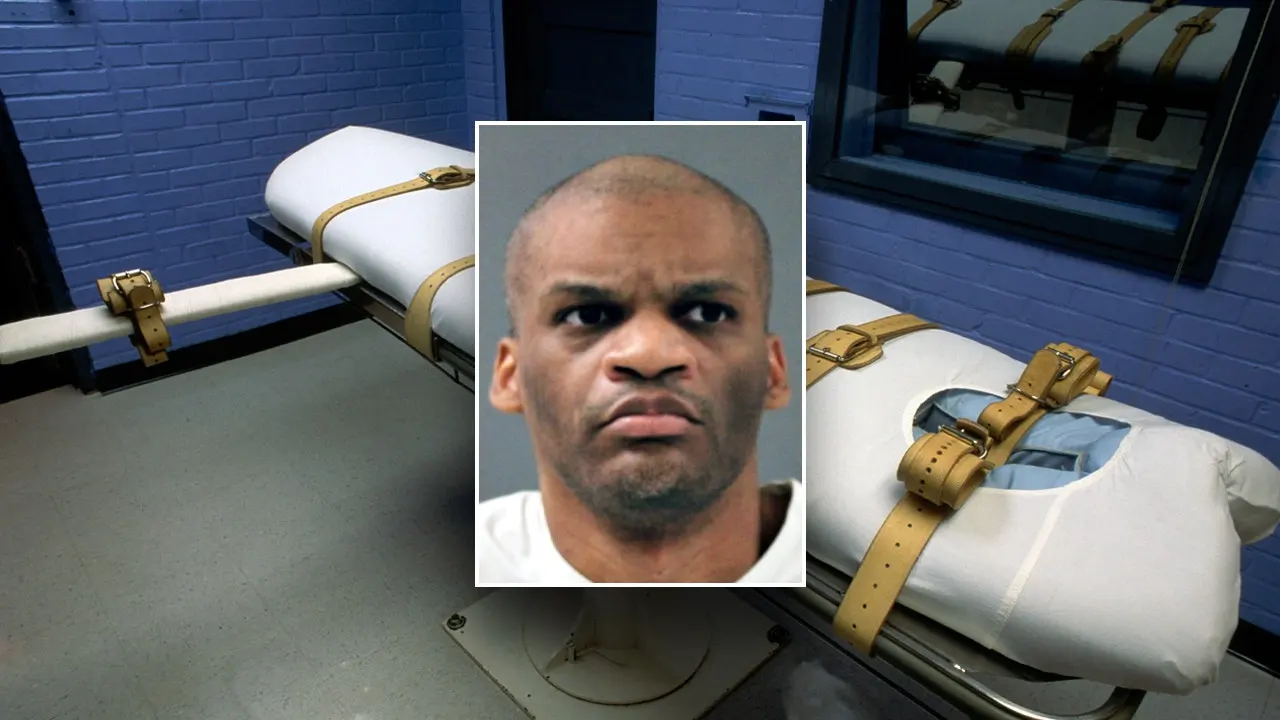
More than two decades after a 2005 home robbery in a small Texas community left three people without their lives, the long-running legal case involving LeJames Norman has reached its final chapter.
Norman, 40, was executed by lethal injection at the state penitentiary in Huntsville on Wednesday evening, September 16, after the U.S. Supreme Court declined to stop the scheduled procedure.
He became the fifth person to receive a death sentence in Texas this year. According to the Texas Department of Criminal Justice, Norman was pronounced deceased at 6:44 p.m.
The case dates back to August 24, 2005, when Norman and his co-defendant, Ker’Sean Olajuwa Ramey, went to a home in Edna, a rural community about 100 miles southwest of Houston.
According to court records, the two men believed cocaine was being kept inside the residence and intended to take it.
They never found the drugs they were looking for.
Instead, an encounter inside the home escalated, leaving three people — Samuel Roberts, 24, Tiffani Peacock, 18, and Celso Lopez, 38 — fatally wounded.
Court records provide a detailed account of what investigators said happened inside the residence.
Lopez, who was a tenant in the home, answered the door when Norman and Ramey arrived. Norman shot him before Lopez moved toward another room.
Roberts and Peacock later arrived at the home. A confrontation followed, and both were struck by gunfire.
The court record states that Norman and Ramey were involved in the shooting of Roberts, while Ramey later went into another room and fired additional shots at Lopez.
The investigation continued after the two men left the area.
Norman eventually fled to Mexico, but about five months later he was apprehended by Border Patrol while attempting to re-enter the United States.
After his arrest, Norman cooperated with investigators and provided statements about the case. He later testified for prosecutors during Ramey’s trial.
In 2008, Norman pleaded guilty to capital murder.
A jury then determined that he should receive a death sentence.
That decision began a legal process that continued for many years.
Norman’s attorneys filed multiple appeals in state and federal courts, challenging aspects of his conviction and sentence.
His most recent legal effort reached the U.S. Supreme Court just days before the scheduled execution.
His attorneys argued, among other things, that prosecutors had presented information differently during Norman’s case and Ramey’s case in a way that made Norman appear more responsible for the shootings.
The Supreme Court ultimately declined to intervene, leaving the execution schedule in place.
There was also a separate legal dispute surrounding the method Texas planned to use.
Norman and another Texas death-row prisoner had challenged the state’s use of pentobarbital in lethal injections. Their lawsuit raised questions about the state’s supply of the drug and how it was obtained and tested.
Those efforts did not stop Norman’s execution.
The Texas Board of Pardons and Paroles had also declined to recommend reducing his sentence or granting a 90-day reprieve.

His final moments
At the Huntsville prison on Wednesday evening, Norman was given an opportunity to make a final statement.
According to reports, he declined.
When the warden asked whether he wanted to say anything, Norman shook his head.
His sister, two of his children and a friend were present to witness the procedure from a nearby viewing area.
Norman was then administered the lethal injection.
The Texas Department of Criminal Justice later confirmed that he was pronounced deceased at 6:44 p.m.
The execution brought an end to Norman’s individual case, but the broader story surrounding the 2005 incident is not completely finished.
His co-defendant, Ker’Sean Ramey, also received a death sentence for his role in the same case.
Ramey’s execution is currently scheduled for September 23, 2026, one week after Norman’s.
That means the Edna case is expected to return to the national spotlight again within days.
A case that lasted 21 years
The time between the original incident and Norman’s execution highlights how lengthy capital cases can become.
The 2005 robbery happened when Norman was still a young man. His conviction came in 2008, but appeals and other legal proceedings continued for years afterward.
His final attempts to challenge the sentence were still being considered shortly before the scheduled execution.
The Supreme Court’s decision ultimately left Texas free to proceed.
For the families connected to the three people who lost their lives in 2005, the conclusion of Norman’s case marks another significant moment after years of waiting.
For the state, it represents the fifth execution carried out in Texas during 2026.
And for the legal system, the case demonstrates how a conviction and death sentence can remain under review through multiple levels of court for many years.
The story will not necessarily end with Norman’s execution.
Ramey’s scheduled September 23 proceeding remains ahead, while the historical record of the Edna case continues to be examined through court documents and the testimony surrounding both defendants.
For now, however, the legal proceedings involving LeJames Norman have reached their conclusion.
Twenty-one years after investigators say the robbery began in a small Texas home, the sentence imposed on Norman in 2008 has now been carried out.
The remaining chapter belongs to the court proceedings surrounding his co-defendant — and to the families who have spent more than two decades living with the consequences of what happened that August night in Edna.