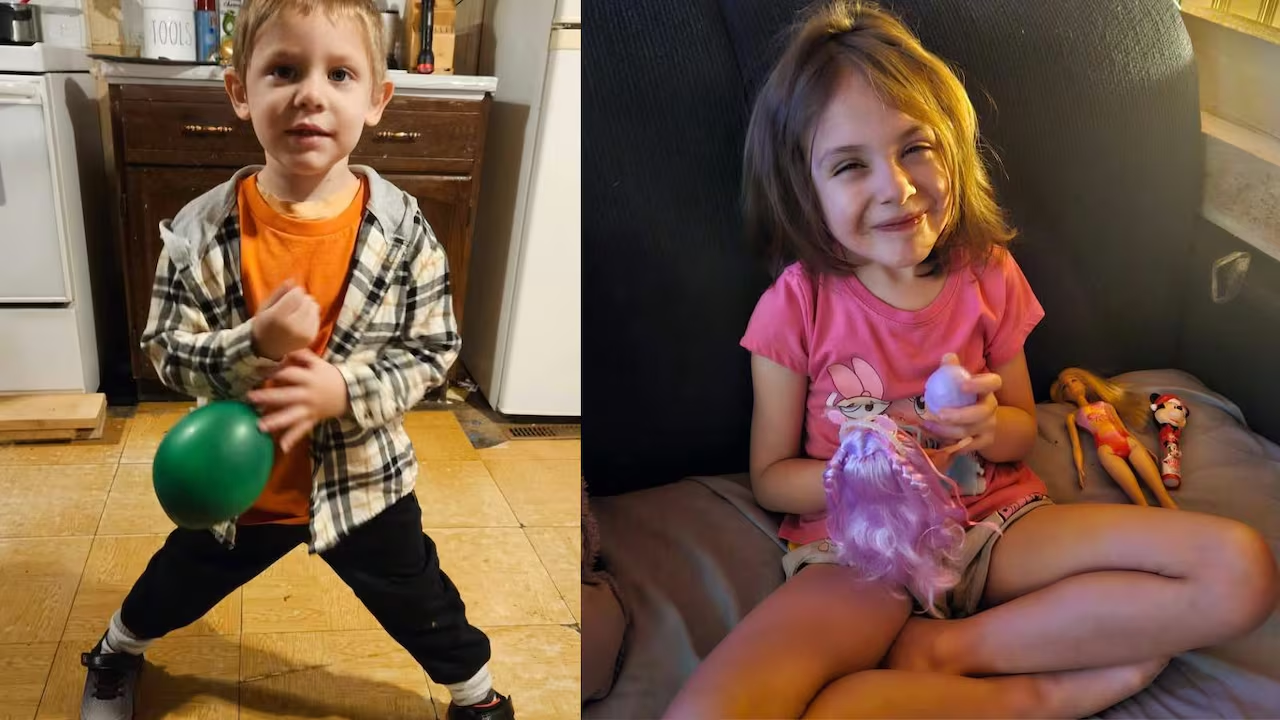
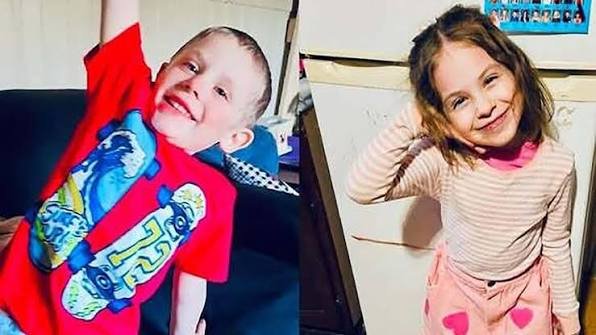
Fifteen months after two young siblings vanished from their rural Nova Scotia home, the mystery surrounding Jack and Lilly Sullivan remains unresolved, with no confirmed sighting of either child since the morning they disappeared and no public explanation for what happened to them.
Now, for the first time in months, their mother, Malehya Brooks-Murray, has spoken publicly about the disappearance in an emotional interview with CBC News and The Globe and Mail. Despite the extraordinary length of time that has passed, Brooks-Murray says she continues to believe that her children are alive and that one day they may return home.
Her comments come as the investigation reaches a painful milestone. Jack, who was four when he disappeared, and Lilly, who was six, have now been missing for more than a year. The Royal Canadian Mounted Police continue to investigate, but authorities have not publicly identified a suspect or announced any criminal charges connected to the children’s disappearance. The case remains officially classified as a missing-person investigation.
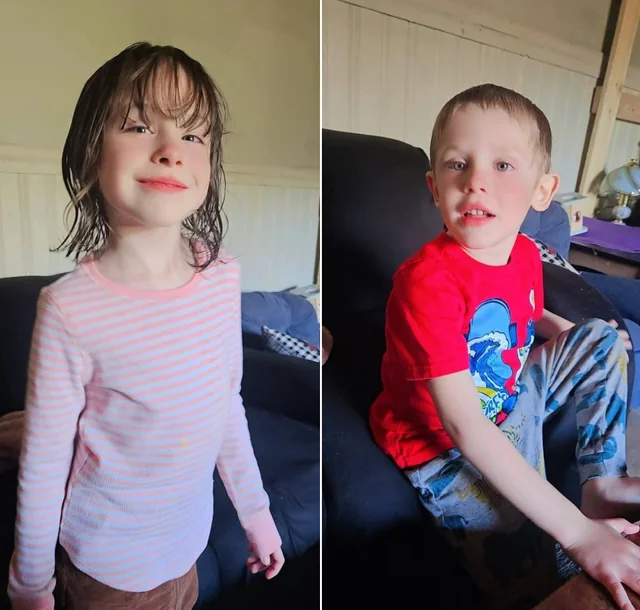
For Brooks-Murray, however, the passage of time has not erased the possibility of seeing her children again.
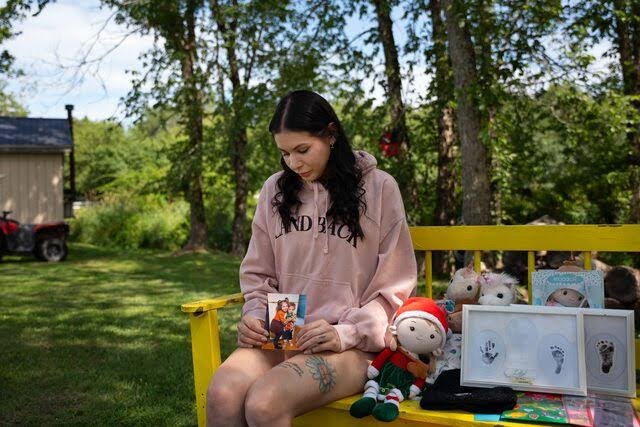
She told CBC and The Globe and Mail that she continues to live with the expectation that Jack and Lilly could eventually come home. At night, she sleeps with some of their favorite stuffed animals, including a white unicorn with a pink bow and a green-and-blue brachiosaurus. She has also kept birthday and other gifts for the children, imagining that they might one day be able to open them.
“I have dreams about them coming home and I believe it,” she said in the interview.
Her decision to speak now is notable because she has largely remained out of the public spotlight since the children disappeared. The absence of public statements had generated criticism and speculation, but Brooks-Murray said she does not believe she owes the public an explanation for how she has handled the disappearance.
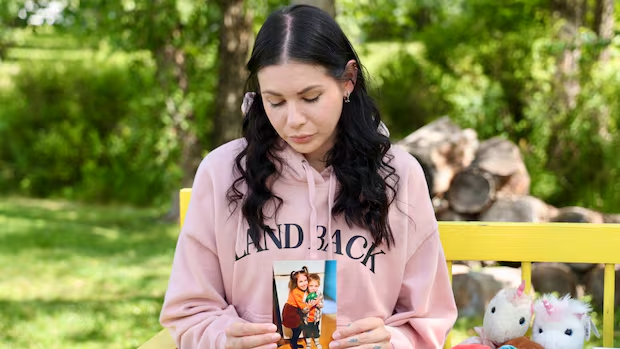
Instead, she said she is the person who deserves answers.
“I don’t feel I owe people anything,” she said. “If anything, I’m owed answers and to have my children back to me.”
Jack and Lilly were reported missing on May 2, 2025, from their home on Gairloch Road in Lansdowne Station, a rural community in Pictou County, about 140 kilometres north of Halifax.
According to the account given to police, the children had been inside the family home that morning. Brooks-Murray has said she last saw Lilly when the girl briefly entered her bedroom. She then heard Lilly and Jack playing elsewhere in the house before falling back asleep. When she woke, the children were no longer there.
The disappearance immediately triggered a massive search.
Police officers, ground-search teams and volunteers searched the heavily wooded area surrounding the property. Helicopters and drones were deployed, including equipment capable of detecting heat signatures. Police divers searched nearby waterways, while specially trained dogs were also used during the operation.
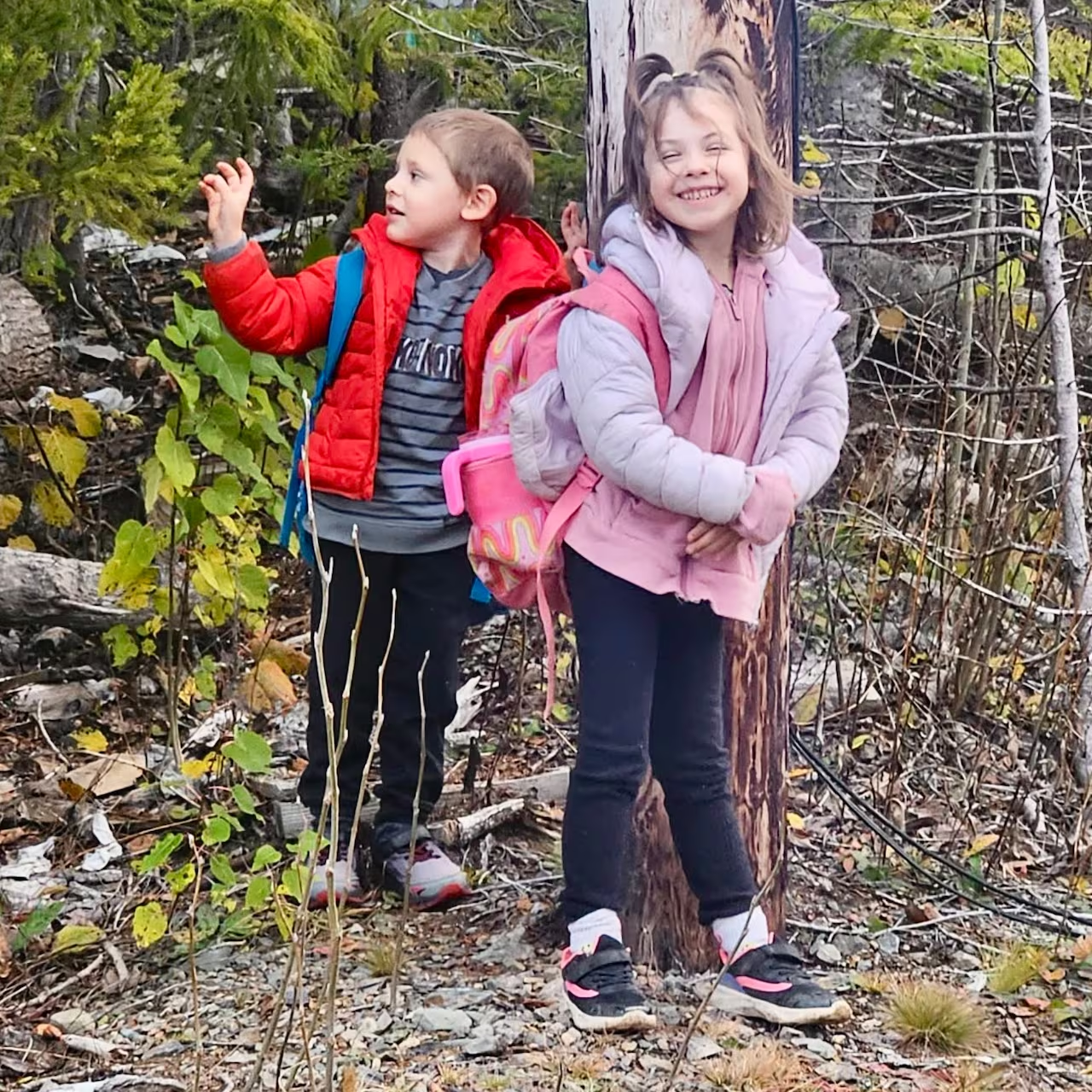
At the height of the initial search, roughly 160 people were involved.
But despite the enormous effort, investigators did not find Jack or Lilly.
The initial search was scaled back after several days, although additional searches were carried out afterward. Investigators have continued examining information and evidence connected to the disappearance long after the large-scale search operation ended.
Police have said the surrounding terrain is challenging, with thick woods and difficult areas of brush. The fact that two very young children disappeared without leaving behind a clear trail has remained one of the most troubling aspects of the case.
Early in the investigation, authorities said they believed the children may have wandered away from the property. Police repeatedly emphasized that there was no evidence establishing an abduction.
More than a year later, that position has not fundamentally changed.
In April 2026, as the first anniversary of the disappearance approached, Staff Sgt. Rob McCamon, the officer in charge of the RCMP’s major-crime investigation, said police still had no evidence indicating that the children had been abducted or that a criminal offence had occurred.
He also said investigators believed the chances of Jack and Lilly still being alive were “very slim.”
That assessment was painful for the family, but police simultaneously stressed that the investigation had not been abandoned.
McCamon said investigators continued to want answers and were still actively pursuing information that could help explain what happened to the children.
Police have also repeatedly urged members of the public to distinguish between useful information and speculation. Investigators have asked people to provide specific, verifiable details rather than theories circulating online.
That distinction has become increasingly important as the case has attracted enormous public attention.
The disappearance has generated widespread discussion across Canada, with online communities and volunteer organizations continuing to examine possible explanations. But despite hundreds of tips and extensive investigative work, no publicly confirmed information has led authorities to Jack and Lilly.
The Nova Scotia government has offered a reward of up to $150,000 Canadian for information that has investigative value in the case.
The investigation has also involved an extraordinary amount of digital and forensic work. Police have examined surveillance footage and other video sources from the surrounding area and have pursued court-authorized access to records that could potentially shed light on the children’s movements or the movements of other people around the time they disappeared.
Court documents released during the investigation have provided additional details about the police response and the information investigators were examining.
Among the information made public was the fact that Jack and Lilly had been seen with family members on May 1, the day before they disappeared. Surveillance footage reportedly captured the family at a Dollarama store in nearby New Glasgow.
That detail became significant because it established that the children were seen in public less than 24 hours before they were reported missing.
Investigators have also examined information involving the children’s biological father, Cody Sullivan. Shortly after the disappearance, police were told that he might have taken the children to New Brunswick. Officers went to his home during the early morning hours of May 3, and he told police he had not seen Jack and Lilly for several years.
Police later sought surveillance information from locations along routes leading toward New Brunswick.
The possibility that the children had been transported elsewhere was therefore investigated, but authorities have not publicly confirmed evidence showing that Jack and Lilly were taken across the provincial border.
Another reported lead involved a witness who told police she believed she had seen two children walking along a road near the area around the time of the disappearance. According to court documents, the witness described a young girl holding the hand of a younger boy and a woman waiting near a vehicle.
Investigators examined the report, but publicly released documents indicated that none of the tips received at that stage had been corroborated in a way that established the children’s location.
This is an important distinction in a case that has generated so many theories: a reported sighting is not the same as a confirmed sighting.
Police must determine whether a witness actually saw the missing children, whether the timing is accurate and whether other evidence supports the account.
So far, no publicly disclosed lead has answered those questions.
The family situation has also received significant scrutiny.
Jack and Lilly lived with their mother, their stepfather Daniel Martell and their younger sister at the rural property. After the disappearance, Brooks-Murray left the home with her younger daughter and went to stay with relatives.
Previously released court documents also contained allegations Brooks-Murray made about her relationship with Martell. Those allegations have been disputed by Martell. The details have attracted considerable attention, but they should not be confused with proof about what happened to Jack and Lilly.
Martell was later charged in January 2026 with sexual assault, assault and forcible confinement involving an adult victim. Police have stated that those charges are unrelated to the disappearance of Jack and Lilly.
He has not been charged in connection with the children’s disappearance.
The distinction is crucial because the absence of charges does not establish innocence or guilt in relation to the missing-person investigation. It simply means that authorities have not publicly announced criminal charges against him concerning Jack and Lilly.
The same principle applies to the children’s mother and biological father. No public evidence has established that any of them caused the children’s disappearance.
As the investigation continued, some observers questioned why police had not classified the case as criminal. But investigators have explained that they need evidence before making that determination.
In April 2026, McCamon said police were seeking facts that could be verified and that investigative decisions would be based on evidence collected by investigators.
That leaves the case in an unusual position.
Police have not ruled out every possible explanation, but they have not publicly established that a crime occurred either.
An accident remains one possibility. An unexplained disappearance remains another. Criminal involvement has not been ruled out entirely, but authorities have said they do not currently have evidence proving an abduction or other criminal offence.
For Brooks-Murray, the uncertainty is agonizing.
She has spent more than a year without knowing where her children are or what happened to them. Yet she has continued to hold onto the possibility that they are somewhere and could eventually return.
Her private life has become a form of waiting.
The stuffed animals remain with her. Gifts remain unopened. Memories of the children remain part of her daily routine.
And while investigators have urged the public to be realistic about the passage of time, Brooks-Murray has chosen not to abandon hope.
That hope exists alongside the police assessment that the chances of the children being alive are very slim.
Those two positions can exist simultaneously because neither provides the certainty the family desperately needs.
Police do not have the evidence necessary to say where Jack and Lilly are.
The family does not have the evidence necessary to know what happened to them.
And that is why the investigation continues.
The case has also demonstrated how difficult missing-child investigations can become when there is no clear crime scene, no confirmed last location and no reliable trail leading investigators toward the children.
In a conventional criminal investigation, authorities may have physical evidence, witnesses or surveillance footage pointing toward a specific event. In the Sullivan case, investigators have had to reconstruct an increasingly complicated timeline from fragments of information.
The children were seen with family members on May 1. They were reported missing the following morning. Search teams quickly flooded the surrounding area, yet no confirmed trace of them was found.
That gap is at the heart of the mystery.
Where did Jack and Lilly go?
Did they leave the property on their own?
Did someone else take them?
Could they have entered an area that searchers overlooked?
Were they transported somewhere else?
Or did something happen that investigators have not yet discovered?
Those questions remain unanswered.
Police have continued to insist that rumors and speculation will not solve the case. What they need is information that can be tested against evidence.
For the family, that means every credible lead remains important.
For the public, it means remembering that not every theory shared online is evidence.
More than 15 months after Jack and Lilly disappeared, there is still no confirmed location for either child.
There is also no public evidence proving that they are alive.
But there is equally no publicly released evidence that conclusively establishes what happened to them.
Their mother continues to believe they will come home.
That belief has become one of the most enduring elements of the case.
While investigators continue to work quietly behind the scenes, Brooks-Murray is left with memories, unanswered questions and the hope that somewhere, somehow, her children are still waiting to be found.
For now, Jack and Lilly Sullivan remain missing.
And after more than a year, their family is still waiting for the one thing they have never received: an answer.