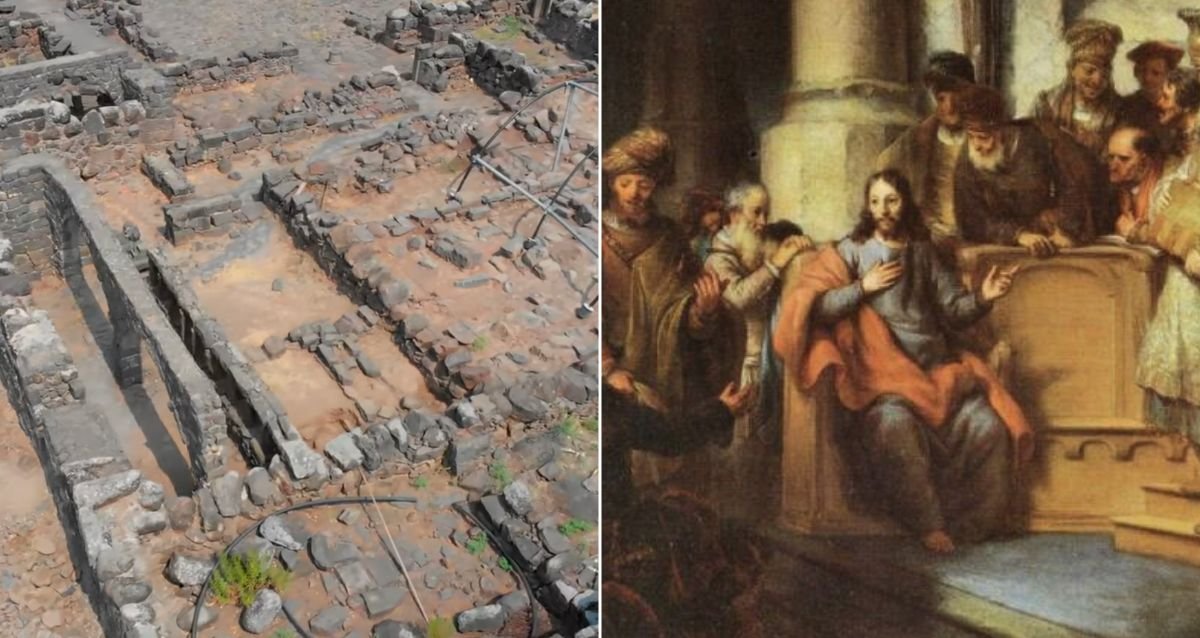
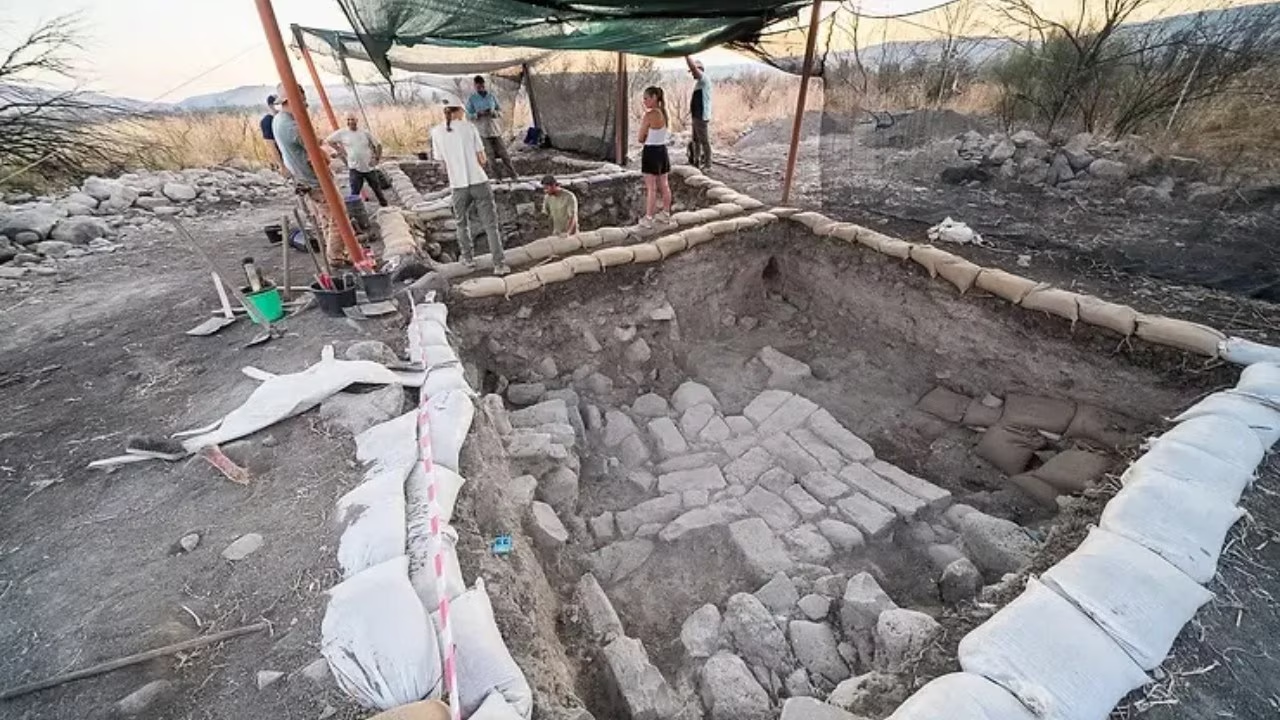
After nearly a decade of digging along the shores of the Sea of Galilee, archaeologists say they have reached what may be their strongest case yet for identifying the ruins of a long-lost biblical city associated with Jesus and several of his apostles.
The site, known today as el-Araj in northern Israel, has been the focus of archaeological excavations for years. Now, after the team’s 10th season of work, researchers say the growing collection of artifacts, buildings and historical evidence has made them increasingly confident that the ancient settlement was Bethsaida — the city described in the Gospels as the home of Peter, Andrew and Philip.
The discovery does not prove that the biblical miracles occurred.
Archaeology cannot establish whether a miracle happened thousands of years ago. What it can do is determine whether an ancient settlement matches the geographical, cultural and historical setting described in ancient texts.
And at el-Araj, researchers say the pieces are increasingly fitting together.
A city buried beneath the shores of the Sea of Galilee
Bethsaida occupies an unusual place in the New Testament.
The Gospels identify it as the hometown of apostles Peter, Andrew and Philip. It is also associated with accounts of Jesus healing a blind man and with the feeding of thousands.
For centuries, however, the precise location of the ancient city has remained a subject of archaeological debate.
One of the leading candidates has been el-Araj, a site near the northern shore of the Sea of Galilee and close to the Jordan River.
The Bethsaida-Julias excavation team has now spent roughly a decade examining the remains there.
The latest season has produced another collection of artifacts and architectural remains that researchers say strengthens their identification of the site.
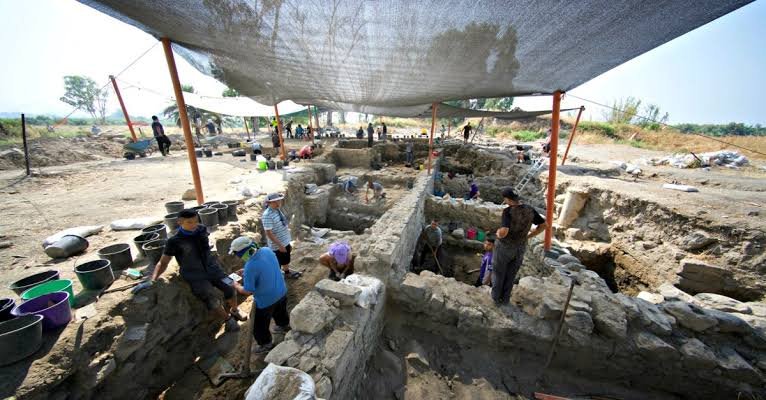
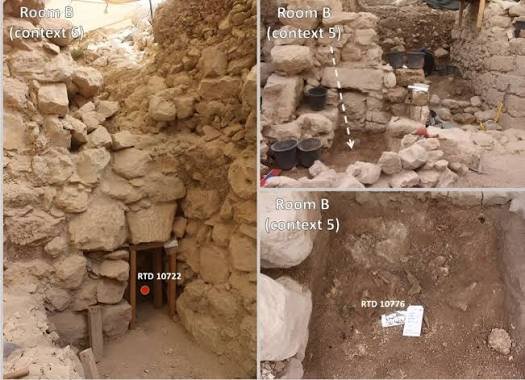
Among the discoveries are Roman-period walls, coins, a basalt mortar or grinding stone and part of a Doric architectural capital that may once have decorated a public building.
Archaeologists also uncovered evidence suggesting that the Roman settlement may have been built over an earlier Hellenistic community.
Together, the discoveries are helping researchers reconstruct what life at the settlement may have looked like from the first century onward.
Artifacts pointing to a Jewish community in the first century
Some of the most significant discoveries may appear ordinary at first.
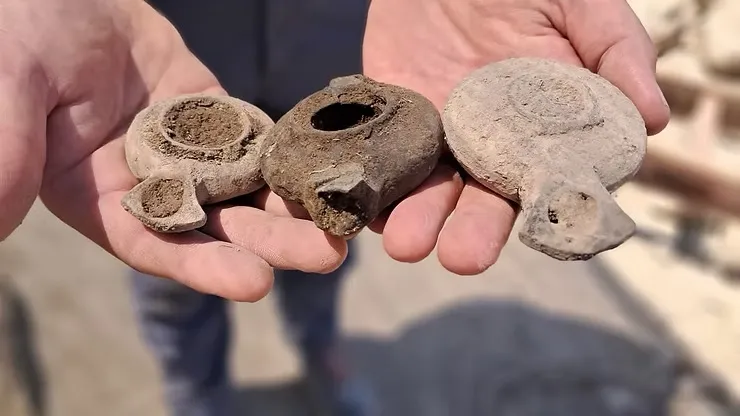
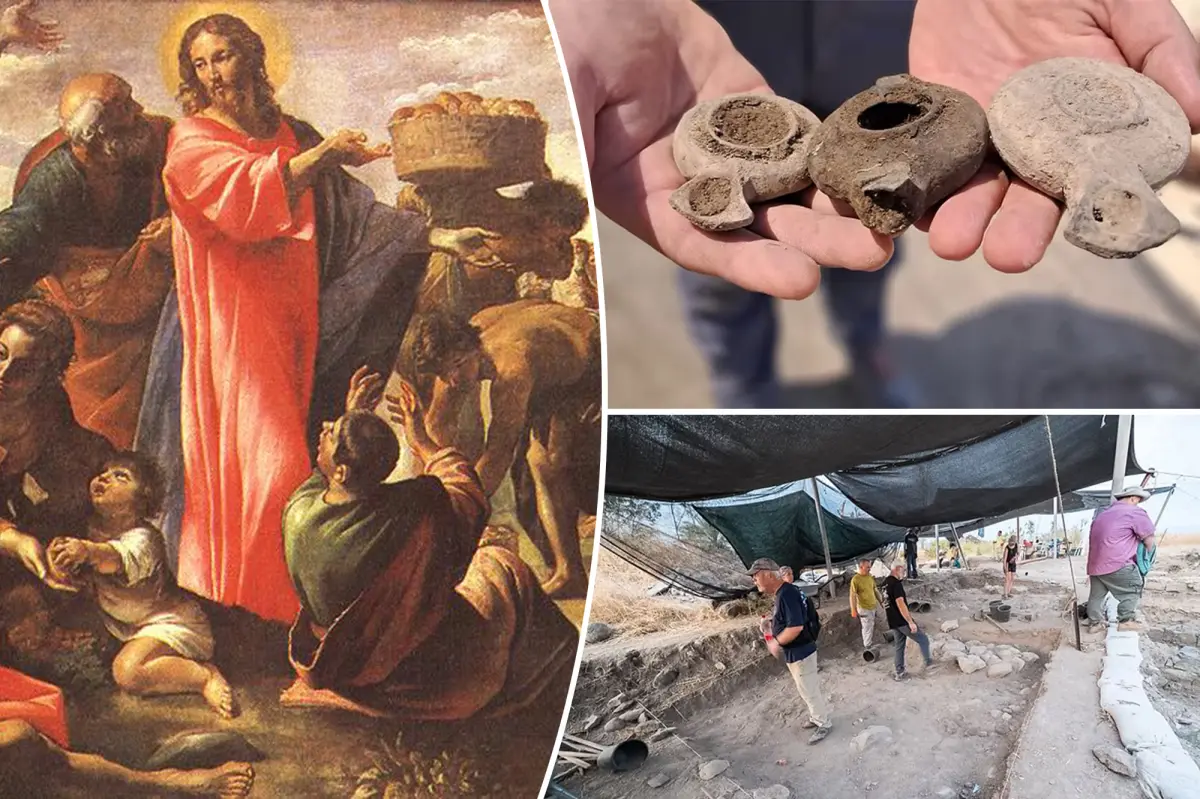
The excavation team recovered chalk stoneware and several Herodian lamps.
Those lamps are particularly important because they were manufactured in Jerusalem before the destruction of the Second Temple in A.D. 70.
Their presence at el-Araj provides evidence that Jewish residents were living at the site during the first century — the period when Jesus and his disciples are traditionally placed in Galilee.
Researchers also found coins, household objects, fishing-related materials and other artifacts spread across different excavation areas.
Rather than pointing to a temporary camp or a handful of isolated structures, the discoveries are beginning to reveal a settlement with homes, public architecture, commerce and an economy connected to fishing.
That matters because Bethsaida is described in the New Testament as a fishing community.
The archaeological picture emerging from el-Araj therefore fits several elements of the historical description.
From Bethsaida to Julias
The site also appears to tell a story of transformation.
Researchers believe the settlement was known as Bethsaida before becoming associated with the Roman city of Julias during the first century.
The archaeological evidence indicates that the community developed over time, with Roman-period construction appearing above earlier layers.
That development is significant because it places the settlement within the broader political and cultural changes taking place in Galilee during the Roman period.
The discoveries also challenge a simplistic picture of Galilee as a region made up only of impoverished rural villages.
The remains at el-Araj suggest that at least some communities in the area had access to substantial architecture, manufactured goods and connections to wider economic networks.
The half of a Doric capital discovered during the latest work is one example.
Researchers believe it may have belonged to a public structure, suggesting that the settlement had architectural ambitions beyond simple residential buildings.
Evidence of fishing fits the biblical picture
The location itself is another important piece of the puzzle.
El-Araj sits close to the Sea of Galilee, an environment that would have supported a fishing-based community.
Archaeologists have recovered fishing weights and other evidence consistent with a settlement whose residents made use of the lake.
That becomes particularly interesting when compared with the biblical descriptions of Bethsaida.
Peter and Andrew are described as fishermen, while Philip is also identified as being from Bethsaida.
The archaeological evidence does not identify those individuals personally. There is no inscription saying that Peter lived in a particular house at el-Araj.
Instead, researchers are looking at the entire collection of evidence: the location, the chronology, the Jewish material culture, the fishing economy and later Christian associations with the site.
That accumulated evidence is what archaeologists say has made the identification increasingly convincing.
A later church adds another important clue
The evidence does not stop with the Roman-era remains.
Archaeologists have also uncovered the remains of a Byzantine-period church at the site.
A Greek mosaic inscription associated with the church invokes the “chief of the apostles” and the “keeper of the keys of heaven” — descriptions traditionally connected with Peter.
The church was constructed over earlier remains, adding another layer to the site’s history.
Researchers have connected this evidence with ancient Christian traditions that associated the location with Peter and Andrew.
There is also a much later written account that has attracted attention from the excavation team.
An eighth-century pilgrim, Willibald, described visiting a church at Bethsaida that was associated with the home of Peter and Andrew.
The account cannot independently prove that el-Araj was Peter’s actual home.
But when combined with the archaeological remains and the site’s location, researchers argue that it adds another piece to the larger historical picture.
Why the discovery matters to the story of Jesus
The importance of Bethsaida goes beyond simply finding another ancient settlement.
According to the Gospels, Jesus spent time in and around the towns and villages of Galilee.
Bethsaida is specifically connected with several important episodes.
The Gospel of Mark describes Jesus healing a blind man there.
The Gospels also associate the surrounding area with the feeding of the 5,000, one of the best-known miracles in the New Testament.
And the city is identified as the birthplace of three of Jesus’ apostles: Peter, Andrew and Philip.
If el-Araj is indeed Bethsaida, archaeologists would have identified the physical remains of a city that occupied a meaningful place in the earliest Christian tradition.
But there is an important distinction.
The excavation does not provide archaeological proof that Jesus performed those miracles.
Instead, it provides evidence that a real first-century Jewish settlement existed at a location that researchers believe matches the Bethsaida described in the biblical accounts.
That distinction is crucial.
The archaeological discovery concerns the place.
The biblical accounts concern the events associated with that place.
There is still another candidate
The identification is not universally settled.
Another archaeological site, et-Tell, has also been proposed as the location of ancient Bethsaida.
Et-Tell contains substantial remains from earlier periods and has long been considered a serious candidate by archaeologists who argue that changing water levels and the ancient landscape could explain why the site is now farther from the shoreline.
That means the debate is not simply over.
The el-Araj team believes the accumulated evidence now strongly favors its site, but archaeology often advances through competing interpretations rather than a single discovery that ends every disagreement.
The latest excavation adds weight to the el-Araj argument, particularly because the site contains evidence of a first-century Jewish settlement, fishing activity, Roman urban development and later Christian associations.
Still, researchers must continue comparing the evidence from both locations.
A picture emerging one artifact at a time
One of the most interesting aspects of the excavation is that there has been no single object that suddenly settled the question.
Instead, researchers have spent years collecting small pieces of evidence.
A lamp.
A coin.
A wall.
A grinding stone.
Fishing weights.
Stone vessels.
Architectural fragments.
Later Christian remains.
Each discovery adds another detail to the picture.
According to excavation director Steven Notley, it is the accumulation of evidence from different parts of the site that has made the identification increasingly compelling.
That approach is important because ancient cities rarely come with modern signs identifying them.
Archaeologists instead have to reconstruct their identities through layers of occupation, artifacts, architecture, geography and historical references.
At el-Araj, those layers appear to be telling a remarkably coherent story.
What archaeologists can — and cannot — prove
The renewed attention surrounding the discovery has also produced some dramatic headlines claiming that archaeologists have definitively found the city where Jesus performed miracles.
The reality is more nuanced.
Researchers are confident in their archaeological interpretation, but that confidence should not be confused with proof of the supernatural events described in the Bible.
No archaeological artifact can demonstrate that Jesus healed a blind man or multiplied food.
What archaeology can show is whether the city described in ancient writings existed and whether its characteristics match the historical record.
In that respect, el-Araj has become increasingly significant.
The evidence points toward a substantial Jewish settlement on the Sea of Galilee during the period associated with Jesus, followed by Roman development and later Christian activity connected with the memory of the apostles.
That makes the site important even beyond the question of whether it ultimately receives universal recognition as Bethsaida.
The excavation is not over
After 10 seasons of excavation, researchers are not walking away from el-Araj.
Another excavation session is expected to begin in October.
That means more layers remain to be investigated and more evidence could emerge.
The coming work may help clarify the earliest settlement at the site, the transition from Bethsaida to Julias, the nature of its public buildings and the development of the later Christian community.
It could also provide additional evidence in the long-running debate between el-Araj and et-Tell.
For now, however, the archaeological team believes the case for el-Araj has become stronger than ever.
After years of excavation, the ruins beside the Sea of Galilee are no longer simply an unidentified ancient settlement.
They are increasingly being interpreted as the remains of Bethsaida, the biblical city linked to Peter, Andrew and Philip and to several of the most memorable stories about Jesus.
The discovery cannot prove a miracle.
But it may bring archaeologists closer to identifying the real city behind the stories — a city that disappeared beneath centuries of history and is now slowly emerging again from the ground.